


Transforming Tribal Education: From Eklavya to Excellence
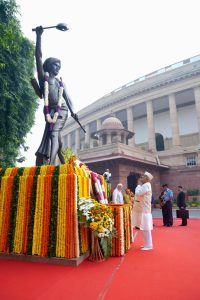
– by C.P. Radhakrishnan
Vice-President of Bharat
I have always firmly believed that educating a child is not only about shaping an individual’s future. It is about transforming families, strengthening communities, and building a progressive nation. When I got an opportunity to serve the tribal areas of Jharkhand, Maharashtra, and Telangana, I always placed a special emphasis on tribal education. I always urged the universities to connect students with School Connect programme so that no child is left behind. Today as we celebrate Janjatiya Gaurav Diwas on 15th November to mark the birth anniversary of Bhagwan Birsa Munda, one of the greatest tribal freedom fighters and a symbol of courage, sacrifice, and resistance against colonial oppression. I feel that a fitting way to pay homage to all our great tribal freedom fighters, will be transforming the education and skilling system for tribal children, so that they not only empower themselves, but also the society.
As Bharat forges a new path ahead across almost every sector, the Eklavya Model Residential Schools (EMRS) are silently redefining the educational landscape of tribal children. These residential schools are established for tribal children within their own community setting, with the objective of ensuring their holistic development. The name, ‘Eklavya’, in itself carries a deeply inspiring message. In the Mahabharata, Eklavya was a young man who, despite being denied formal access to education, demonstrated extraordinary dedication, discipline, and determination to master the art of archery. His story serves as a reminder that talent combined with the desire to learn can overcome even the greatest obstacles. Today, the Eklavya Model Residential Schools represent a new chapter in this story. Through the EMRS Scheme, our tribal children are being provided institutional support, quality education, and opportunities to realise their dreams.
The scheme, which is implemented by the Ministry of Tribal Affairs gained a fresh impetus under the visionary leadership of our Hon’ble Prime Minister, Shriman Narendra Modiji. In the Union Budget of the year 2018-19, Shriman Modiji expanded the coverage of the Scheme and envisioned one EMRS in every block having more than 50% ST population and at least 20,000 tribal persons, as per Census 2011. With this single move, our Hon’ble Prime Minister has brought CBSE-affiliated education to remote locations that were earlier without access to such schools.
The EMRS scheme is unique in its design and mandate. It has a strong focus on inclusive and equitable education for tribal children. As compared to the 7.5% reservation for Scheduled Tribes in other schools, at least 90% of students in the EMRS Schools belong to the tribal communities. What is even more heartening is that 50% of seats are reserved for girls, which is an excellent positive step. Admissions are conducted through a State-level entrance test, with preference given to local students.
If we see the evolution of the EMRS, it can be traced in 2 phases. During the first phase from 1997-2018, a total of 288 schools were sanctioned. The first phase faced several structural challenges. The novelty of the EMRS 2.0 Scheme, operationalised from 2018 onwards, lies in addressing the limitations of the earlier existing models of educating tribal children. The scheme places special emphasis on first-generation learners and also recognises the learning gaps they may face. To address these challenges, structured academic support is provided through Learning Gap Assessments, bridge courses, and remedial classes. In the initial classes, bilingual teaching is adopted, enabling children to learn comfortably in their familiar language, followed by a gradual transition to English as the medium of instruction. I was glad to learn from the Tribal Affairs Ministry that EMRS 3.0 is operationalised from this year.
Another significant measure in EMRS 2.0 was the establishment of National Education Society for Tribal Students (NESTS) in 2019 under the Ministry of Tribal Affairs to establish, endow, maintain, control and manage the EMRS. To ensure that every child receives the right academic foundation, NESTS has mandated a 65-day Bridge Course for all newly admitted Class VI students, based on an assessment of individual learning needs. Special emphasis is being placed on addressing foundational learning gaps and strengthening communication skills through dedicated English modules.
EMRS are now managed by State Government Societies as per the guidelines and norms formulated by NESTS and the Ministry. A District Level Committee under the supervision of the District Collector supervises the functioning of the schools in each district, and the Principal is the overall in-charge of each school. To strengthen accountability, a district ranking system based on the performance of EMRS has been introduced to promote inter-departmental convergence and timely resolution of issues. A Key Performance Index assessing the annual performance of each school across seven domains comprising 31 indicators has also been devised.
Under EMRS 2.0, 440 new schools are sanctioned in tribal blocks on the twin criteria of more than 50% ST population and at least 20,000 tribal persons. Initially, the capital cost per school was set at Rs. 20 crores for plain areas; and for North-East, hilly and LWE-affected areas it was set to Rs. 24 crores. The capital costs have been further enhanced in 2021 to Rs. 37.80 crores and Rs. 48 crores respectively. Since the beginning of this financial year 2026-2027, the maximum permissible annual expenditure is Rs. 1,47,356 per student, with provision for direct expenditure on students such as mess, uniform, textbooks, medical expenses, CBSE fees, and co-curricular activities.
Recently I had a presentation by the Ministry of Tribal Affairs. I was really pleased to learn that as on today, the total enrolment of EMRS is 1,72,952 students, of which 84,636 are boys and 88,317 are girls. The largest presence of EMRS state-wise is in Odisha (114 schools approved), Jharkhand (91), Chhattisgarh (75), Madhya Pradesh (71) and Gujarat (47). The States of Chhattisgarh and Madhya Pradesh have the highest enrolment, with 28,884 and 26,857 students, respectively.
Education in Eklavya Model Residential Schools is not merely about classroom learning; it is about holistic development and empowerment of tribal students. It aims to equip them with the knowledge, skills and confidence to excel in a rapidly changing world. We are also embracing technology to transform classroom learning. Classrooms are equipped with Smart Boards, with 365 EMRS covered in partnership with MeitY and other schemes. The Medha AI platform supports teachers in lesson planning, content delivery and student evaluation, enabling more personalised and effective learning.
Tribal Corners have been set up in EMRS to preserve and celebrate the heritage, culture and traditions of tribal communities. Sports facilities such as Kho-Kho, basketball, running tracks and archery are available in new schools where sufficient land is available. Schools are also designed with vocational training centres and spaces for art, music and cultural activities. Skill-based subjects aligned with CBSE guidelines have also been introduced under the SANKALP Project.
The achievements of EMRS students are a fitting tribute to the spirit of Janjatiya Gaurav Diwas. I feel really proud that that students from EMRS are now entering IITs, AIIMS and other premier institutions of professional and higher learning. From Rohit, who studied at IIT Roorkee and is now a Data Scientist with Barclays in London, to Simran, who serves as a Captain in the Military Nursing Service, these young achievers demonstrate the transformative power of education. The success of Nima Doma Bhutia in representing the Indian Senior Women’s Basketball Team and the remarkable academic achievements of PVTG students from Chhattisgarh further reinforce this message. Our tribal children need to dream without limits, pursue excellence, and emerge as confident leaders, innovators, and nation-builders.
Bhagwan Birsa Munda inspired generations to stand up for their rights and dignity. EMRS is empowering today’s tribal youth to realise their dreams through education, knowledge and achievement. This is the true spirit of Janjatiya Gaurav Diwas — honouring our glorious past while empowering our tribal communities to shape the future of a Viksit Bharat @ 2047, the rousing call made by our Hon’ble Prime Minister, Shriman Narendra Modi Ji.